frogs in association with divinity ctoniche . In many religions the altar, however, is placed inside a temple dedicated to a god. Sometimes, as in the case of Vestal Roman or Jewish priests , the altar is inaccessible to "lay ," the people. There may, in fact, the only access priests or priestesses, sometimes after specific purification rites. The altar, in these cases is no longer seen as just a place offering or sacrifice, but becomes an "event" of the presence of divinity. Often, or under the same altar, contains objects that "represent" the divine, usually statues or amulets .
the altars of ' ancient Egypt and Mesopotamian peoples indicated both in form and size of the source table dating back to the profane. Consisted of a round or square table made of various materials, such as wood, stone or terra cotta. Among the excavations in the city Babylonian also appeared cube-shaped altars built with bricks. Sometimes the cubic structure and imposing, or in the shape of a cone was preferred by ancient Egyptians. Nell ' Hinduism altars are in fact small and so are sacred shrines and offerings are made here and sacrifices to the gods . We distinguish the altars of the temples (mandir ), more large and accessible only to Brahmins (priests) pujari altars "family", smaller, usually where the worship (puja ) of murti (images of gods ) is normally carried out by the householder. In these altars, as well as images of the gods, there are also lights, pictures of saints and gurus , and offers, usually through the provision of food which is consecrated and becomes prasada . In Jewish culture, under the law of Moses, the ancient altars were to be made of stones and earth is not affected by iron tools ( Exodus 20, 24-25). The Bible also describes the existence of portable altars, made of wood covered with copper-bearing horns at the corners of species, whose origin can be traced back to a sacred symbol. In Greek religion there are altars both domestic altars used for public worship, which in this case or were placed in the temple or outside it. Only in the Hellenistic age altars became monumental, like the one dedicated to Zeus and Athena erected Pergamon , formed from a podium 37 meters high, the base and enriched with decorations inspired by the struggle of the gods against the giants.
In Roman religion the altar called more often the term Latin ara, of uncertain derivation, but many historians date to Ardeo ("burn"), is generally rectangular in shape. Vitruvius requires that the altar of a temple should face east and in a position lower than the cult statue, so that those who pray look up to the gods. The height of the altar, however, varies depending on the type of which is dedicated to the gods: those of the celestial deities, like Jupiter, are very high, while those of marine and terrestrial gods and Vesta are also quite low.
the altar in the Jewish religion
N she Jewish culture rites of supply and demand are closely tied to the place of the altar. The Bible describes the existence of many altars throughout patriarchal history and the prophets, described the genesis and the exodus, reports the construction of altars to the Lord as a testimony to that place , His presence or His meeting with the patriarch or the prophet. Noah (Genesis 8:20), finished the flood builds an altar to the Lord and offers all sorts of animals and burnt. Abraham (Gen. 22.9) by order of Lord builds an altar in the mountains of Moriah to sacrifice his son. Jacob (Gen. 35.1) under the invitation of Lord builds an altar in the land of Bethel as a testimony of the encounter with God and in thanksgiving. Moses (Ex. 24.4 to 8) builds an altar at the foot of Sinai, offers the sacrifice and the blood is two halves: one is given to the Lord (or more exactly, is poured on the altar that represents it) and another sprinkles on the people, so the deal is sealed between the Lord and His people, the First Alliance (Ex 24, 4-8).
In the Temple of Jerusalem there were several altars. In the space between the churchyard and the "Holy " was the site of the altar itself, called the altar of burnt offering , on which every day he offered the sacrifice of the lamb. In "Holy ', with the seven-branched candlestick, were installed on the altar of incense and the table of the "bread of the face," that the offer (these loaves, twelve in number, were renewed every Sabbath ) Finally, in the "holy of holies" there were no altars in the true sense of the word, but a very sacred stone - the stone shethiyah - on which rested the ark, the ark is just for the stone takes on a sacred Christian preconciliar comparable to the altars on which rested the tabernacle. The altar
Jewish, as some of the altars of other religions, usually served to burn the victim in fact did support from the stack of wood on which was placed on the injured be burnt. So is the 'altar of bloody sacrifices, not the site of the killing of the victim (this was done elsewhere because the wood was wet with blood) but where the victim is burned. The offer was not placed on the altar but was sectioned whole array of media and placed according to specific schemes.
Altar in Christianity
First, it is imperative to give attention to the difference between 'pagan altar el' Christian altar: the first, unlike the second , is used to burn the victim. The pagan altar, at least in the classical world, is usually a stone with a special form used to hold firewood. The second, however, always has tablecloth that necessarily refers to the table and the meal. Another element that creates noticeable difference is that the pagan altar is a place of bloody sacrifices (where the victim was burned), the Christian altar, however, is the site of the ritual meal, the place of Manduca.
Where does the Christian altar?
The Eucharist was born in the upper room where there is not an altar but a table. The origin of the Eucharist is the Christian Last Supper of Jesus in Upper Room, is the rite of the Last Supper that have shaped the genesis and development of the Eucharist. All this took place around a table. Originally the altar of the Christian liturgy is the table of the Last Supper.
The word altar
Among the first to talk about the apostle Paul's altar calls him simply "the Lord's table" (1 Cor. 10:21), in this text table of the Eucharistic liturgy is not a proper name and not the name of altar is still defined by what it is: a table but with the clarification: of the Lord. This precision creates an important parallel with the celebration of the Eucharist which is defined precisely, " Lord's Supper."
Since the first generation of Christians the Eucharist is called sacrifice. From this period comes a consequence: if the Lord's Supper is a sacrifice, the Lord's table is the altar. This new way to designate the Lord's table will have great success and will come to fruition as a technical term. The theology that interpreted the Eucharist as sacrifice is cast on the table of celebration, from this moment, it becomes the altar.
The altar primitive era
Among the primitive liturgical sources deserve special consideration Acts of Thomas of the second century. which shows the description of a stool that had been found near a grave and it had been celebrated the Eucharist. The shape of the altar there is nothing specific to their own, this evidence tells us that any object was used as an altar. The oldest depiction of a Christian altar is located in the cemetery of Callistus: it is a three-legged table, apparently mobile, which only occasionally is used for the liturgy. The altar, therefore, did not have a particular form that has characterized it, is its function in the liturgy that makes it " altar."
According to archaeological sources, the earliest models of altar in the shape of a table supported by light supports. The altar has the function of serving the commemoration of the Eucharistic meal, the earliest Christian altars were probably made of wood. In the fourth century. Athanasius in Alexandria said that the army chief Amalario, did break and burn the wooden altar table as it was. Then in the early church are used portable altars, their form was higher shelf so that the celebrant stood to perform the rites. The circular or semicircular in use from the fourth century. The most widely used material is marble, generally supports the rectangular tables are four monolithic columns with the base.
The position of the altar from the first centuries was located in an area protected by a barrier. In African churches this space knows few exceptions in the fourth and fifth centuries in Africa is sometimes the altar in the middle of the nave, surrounded by his fence and connected by a corridor to the apse. In early Christian churches of northern Syria, the altar in the apse is often elevated from the fifth century. is located in a side room. Instead, in the churches of Southern Syria it was located halfway between apse and seats of the clergy.
A Rome was the altar in the apse and the western priest celebrated facing the congregation.
Then in the early Christian era there is a tension between two different conceptions of the liturgy required around the altar: it can offer maximum visibility to the faithful entering the enclosure of the altar in the middle of the nave (as in Africa) or by placing scene in the altar apse. Or, conversely, it can provide some privacy for the priest and the altar in the most essential elements of the liturgy.
The altar Carolingian era
In this era, the space distribution undergoes profound changes in the liturgy. Through the source of the "Sacramentary of Drogon " we learn that the bishop of Metz Drogon built an abbey to Centula where we find many altars. The eastern apse of the altar, the atrium of the church in the west has another altar. The aisles north and south chapels with their home altars.
The Altar and the Second Vatican Council
At number 28 of Sacrosanctum Concilium , is mentioned explicitly in the form and the erection of 'altar must be detached from the wall, turn around and be able to celebrate facing the people. It also raises anew the question about the fate to be reserved for other altars present, is invited to give relief to a single altar.
The General Instruction of the Roman Missal says that the altar should be placed so as to actually build the center, Cardinal Joseph Ratzingher said that the altar is the place that opens to eternal liturgy. The direction of the altar in the east is an expression of cosmic history of the liturgy, if not eastward direction is invited to a " versus crucem .
During the liturgical renewal has not wanted to avoid dropping the altar in two extremes: ieratizzarlo or profane.
The Altar and Christ
Just as the church is called " home of Christ," the same way, the altar is Christ, for this reason the 'altar is incensed and kissed. The altar is a mystery of presence, the relationship between the altar and Christ requires treatment of its own.
Optatus of Milevi wrote a treatise "against the Donatists " to the 365, here we have a lot of information on the design of the altar. He wants to convince his antagonists when the unity of his baptism is the type: the flood and circumcision are figures of baptism, then starting the uniqueness of the flood claims that circumcision and baptism is unique.
The same type of use is made for the altar, the altar is the site of Christ's body, so it's sacred, it is res Of ; precisely For this reason, Ottati as Ambrose, hit the altar is Christ himself hit. Amalario Metz marked the allegorical vision, if the input of the bishop in the church is 'entry of Christ into the world, and the altar is placed the Gospel, here is that the altar represents Jerusalem, the holy city from which you started the proclamation of the gospel. The bishop arrived kisses the altar in memory of the first coming of the Lord which was held in Jerusalem. The identification of the altar to Christ to be found in the relationship between the altar and sacrifice of incorporation for the birth of Christianity is the passion and the destruction of the Jerusalem temple with its sacrificial cult. The experience of the cross meant for his disciples, the end of all hope of redemption in this world. They had to learn to see the sacrifice of his life as a vicarious atonement, in Judaism categories that have been developed and applied by Paul to Jesus
Participation in the fruits of this vicarious sacrifice is not through a new sacrificial action but by receiving the bread and wine. So the primary meaning of the shape of the Christian altar is not the sacrificial altar, but the table to accommodate the food.
According to the typological interpretation - dogmatic: the altar symbolizes Christ, it is a stone, placed in a greased and height. Similarly Christ is the stone, is anointed.
According to the typological interpretation - Representative: Thomas Aquinas said that just as the celebration of the sacrament of the altar is the representative image of the Passion of Christ, the altar represents the cross on which Christ was sacrificed physically.
According to the interpretation tropological - moral: the altar becomes a symbol of faith and heart. Augustine said that man's heart is like an altar to God, in fact on it marks the sacrifice of praise and joy.
According to the interpretation anagogical: Based on the altar of the apocalypse becomes the image of the heavenly altar as the throne of God
from the twelfth century. the symbolism of the altar takes a back seat in favor of the altarpiece, but today it shows the emphasis on the primary function of the altar. If we read the fifth Easter Preface of the Roman Missal, Christ is identified with the altar, it is not only devoured the place but also the transformation of the faithful who receive the Eucharist from it. In the liturgical earthly altar is interwoven with the heavenly altar.
So for this very special value to the altar takes a strong reference to Christ, it becomes important to consecrate and dedicate the altar.
Consecration and Dedication of the Altar
Originally, the consecration occurred just above the altar celebrating the Eucharist, the liturgy of the dedication of the altar was later developed.
The dedication ceremony is found in many religions, as Christians, they have taken from the liturgy of the Old Testament: the book of Numbers describes in fact a blessing of an altar (Num. 7, 10-11) and the First Book of Kings there is another blessing. The Jews still celebrate Chanukah to the Anniversary of the cleansing of the temple and the dedication of the new altar of burnt offering by Judas Maccabeus. Christians continue to make constant allusion. The dedication of the first Christian rites were redundant, and welcomes a symbolic abundant: water, with which the Bishop sprinkled the altar and the whole church in the past was mixed with salt, ashes and wine, and each of these elements was previously the subject of an exorcism and a blessing, the bishop enters the church drew to land the letters of the greek (Celtic custom which he did for this building a place of worship and culture).
today to study the rites the dedication of a church and an altar you have occasional patristic descriptions as the story of Egeria , another source is the Roman Ordines finally the pontifical . The ritual dates from 1977, comprises seven chapters, introduces the difference between the dedication (a term that is used for fixed altar) and blessing (a term that is used for the altar mobile). We find a strong parallel between Christian initiation and dedication of the altar, with the ratio of the church - building and church - mystery.
Like all the rituals of the Vatican, the main rites are placed between the Liturgy of the Word and the Eucharist. This ritual includes a series of preliminary observations that remind the Christian that is itself spiritual altar.
The celebration begins with the entrance of the bishop and the ministers are brought together all'Evangelario, the relics will be placed in a suitable place beside the altar. Following the blessing of water that will be used for spraying, and before the congregation and the altar, then, to note that prayer plays on the analogy with baptism, we continue with the glory and collect prayer that prays for the Christians they come together around the altar.
rites of dedication will start in earnest after the creed with the Litany of the Saints following the signing of the bubble and the deposition of relics in the tomb of the martyrs under the altar. Without such rites is proclaimed the great prayer of dedication, inspired by antique models with a procedure that lists of types in Noah, Abraham and Moses prefigured in which Christ brought.
followed by the anointing of the altar with chrism, which is paid to the four sides and center, is anointed with oil plentiful and you prefer to remain on the stone also patchy. Then we proceed with the incense is placed a brazier on the altar and offered incense and the altar is incensed in all its parts.
now is prepared, it is covered with a tablecloth and candles are put off. Following the lighting with the lighting of candles and a few lights of the church. A culmination of all the Eucharist is celebrated, the prayer over the offerings with its own Preface praising God through Christ.
whole celebration of the dedication is organized on the model of Christian will dedicate the altar as a person dedicated to Christ . At one time this was even more pronounced parallelism to be placed under the altar, fragments of the consecrated host.
So this parallelism ( and dedication of Christian initiation ) is pregnant with meaning ecclesiological, highlights well the relationship between the stone church and the church as a community of Christians
The Altar of the Cathedral Church of Salemi
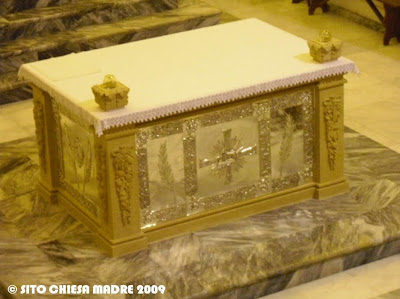
A 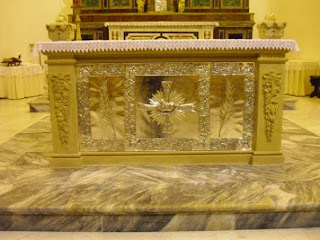 Forty years after the 1968 earthquake which struck the valley of Belice, the present Cathedral Church of Salemi (Ex College Jesuit) was missing its fixed altar and in accordance with the directives of Vatican II.
 The priest Don Salvatore Cyprus, together with the parish community, decided to make the altar and replace it with the previous cabinet table.
The selected design has taken into account materials that are dear to the land of Salem: the local stone called "c ampanedda ," a hard, clear stone, carved (from a mason city ) with garlands of flowers and breads that recall the traditional feast of St. Joseph, dear to the city. The altar is rectangular in shape, rests on a high, visible from anywhere in the church, consists of a stone base "Campanedda", four columns, also of stone, carved supporting the base, also made of stone, weighing about 6 tons.
sides accommodate four panels embossed silver (processed by the silversmiths of Palermo), one for each side: the front shows the cross with the Lamb enthroned above the book of seven seals flanked by two palm trees, symbol of martyrdom and victory, the right side of the altar there is a rectangle with the image of the town's patron, S. Nicola di Bari, on the left side of the image of the round the city's patron, the Immaculate, the back depicts six palms.
On 5 December 2009, the Bishop Domenico Mogavero has dedicated and consecrated the relics of the martyr Saint Thomas Becket and the relics of saints: Ignatius of Loyola (the saint to whom is dedicated the present church sea, the former Jesuit College), Nicola di Bari (patron saint of the parish and owner), Rita da Cascia and Pio of Pietrelcina ( saints dear to the inhabitants to). The choice of relics has been made keeping in mind the relationship that these saints have had and continue to have with the city.
The work produced is worthy of admiration for priests and lay faithful today remains the most dignified altar throughout the diocese. Even with the definitions artistic altar does not lose its value 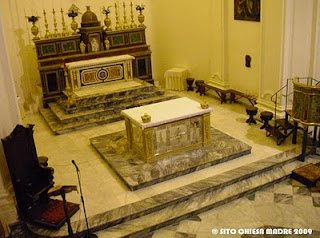 sacred, include as a work of art is not is a modern phenomenon, a number of shrines of the Middle Ages and late Middle Ages, especially those of Renaissance and Baroque art, are intended as works of art that attract or focus the visual axis of the faithful.
 not forget that every altar should not be born anew but should always refer to the history and culture of that place, it is not a sign from him, but because of its destination purpose in the liturgy, is a place of communication between God and man, the altar becomes a place of anamnesis, the center of which is the memory of the mysterium paschale making the altar as a symbol of history of God and humanity, the altar is a particularly sensitive component in the space of the church is the center of the community.
Ratzingher Cardinal Joseph argues that the altar is " so to speak, the place where the sky ripped open, it does not close the space of the Church, but opens him to eternal liturgy "
Alessandro Palermo
_____________________________________
Bibliography
- Jean Hani, The symbolism of the Christian church (p. 115-133), Arkeios Editions, Rome 1996.
- F. Debuyst, P. De Clerck, A. Gerhards and AA. VV., Altar, a mystery of presence, a work of art , Edizioni Qiqajion, Community of Bose 2005.
- celebrate the mystery of Christ, edited by the professors of liturgy, liturgical editions, Rome 1993.
- Dictionary of Liturgy, edited by Domenico Sartore and AA. VV. Edition S. Paul 2001.
- Roman Pontifical, Libreria Editrice Vaticana, 2008.
- Dogmatic Constitution of Vatican II, Sacrosctum concilium 28.
Notes The history of Maya began around 1500 BC in southern Mexico . The Aztecs were one of the great pre-Columbian civilizations. Developed in the region of the Mesoamerican Mexico from the fourteenth century to XVI. chthonic deities The term refers to all those female deities generally related to the cults of gods underground and personification of seismic forces or volcanic . Derived from the Greek word used by Pherecydes Siro to indicate a cosmic deity originally together with Zas (Zeus ) and Kronos : Ctonie ( Χθονίη or Bury, from ' adjective greek χθόνιος meaning underground). The Prasada is part of the gift to the guru or deity that is made to the disciple in the form of grace. Marcus Vitruvius Pollio ( Latin Marcus Vitruvius Pollio c. 80 / 70 BC - 23 BC ) was an architect and writer Roman , the most famous theorist of of all time . The "Saint" was a building in the center of the courtyard of the temple in which was kept the ark of the covenant, was divided into two parts by a thin layer, the inner and more sacred, where he had access to only the high priest and one Once a year, was called "the holy of holies."
Document Syrian the end of the second century. Athanasius the Great said ( Latin : Athanasius ; Alexandria , about 295 - May 2 373 ) was Pope of Alexandria (328-339). His name is inextricably associated with the Theological School of Alexandria, together with Clement and Origen . Old Testament in ivory and silver containing a liturgy for the Bishop of Metz Drogon. head of the Diocese of Milevi, North Africa, he distinguished himself in the fight against the Donatists. He wrote several works, all highly valued by Augustine.
Hanukkah or Chanukah (in Hebrew חנכה , Hanukkah) is a Jewish holiday , also known as the Festival of Lights . In Jewish Chanukkah the word means "dedication" and in fact the holiday commemorates the consecration of a new altar in the Temple of Jerusalem donated after freedom given to them by the Greeks.
Ordo Romanus is a collection of specifications and descriptions of particular liturgical action that, at least originally, was typical of Rome. Before the earthquake of 1968, Madrice of Salemi (XVI - XVII century.) Stood high in the square next to the castle, after the demolition of ' building, the church became the seat of the Jesuit Mother Church.
 Forty years after the 1968 earthquake which struck the valley of Belice, the present Cathedral Church [15] of Salemi (Ex College Jesuit) was missing its fixed altar and in accordance with the directives of Vatican II.
  sacred, include as a work of art is not is a modern phenomenon, a number of shrines of the Middle Ages and late Middle Ages, especially those of Renaissance and Baroque art, are intended as works of art that attract or focus the visual axis of the faithful.


0 comments:
Post a Comment