BULLETIN PARISH CHURCH HISTORY OF ANCIENT HISTORY SALEMI 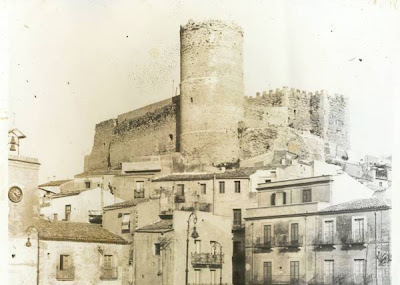 LIST OF CHURCHES AND CONVENTS SALEMI
 According to historical sources that the writer gives us Stanislaus Cremona, a Jesuit in 1762
1) and Oratory of St. Philip Retreat Blacks : we have very little information, in 1630 the Brotherhood of St. John the Baptist gave his church to a group of regular clerics who decided to follow the path of the saint, they manufacture their cells and there lived here, we do not know until they went on this mission but by the end of 700 all was gone .
2) Monastery of the Basilian monks : was fabricated the behest of Queen Constance in 1288, this convent was the site where the resources Successive convent of Santa Chiara, which today houses the library. Until 1778 this church was venerable S. Basil.
3)  Church and Convent of Santa Chiara : It is believed that this convent of Poor Clares, is the oldest in Sicily. The complex is located where once there was the Monastery of the PP. Basilian (1200/1300). The current structure dates from around 1540. The Poor Clares living
this monastery observing the rule of S. Francis and maintained close ties with the Monastery of St. Michele di Mazara del Vallo.
The Church was of middle size, was dedicated to St. Clear. The main altar is a statue of the saint. He had four chapels, one of the Holy Cross that he kept a very good simulacrum, S. Mary Magdalene with a big picture and that of the Holy Family with a small painting believed to be very old. In this Church officiated the festivities were in honor of St. Clare and the Nativity of the Virgin.
Today the church houses the town library, the monastery complex, but once welcomed the ER, then became a nursery.
4) Church of St. Anthony of Padua, was S. Francis, the former Convent of the Conventual : Its foundation dates from 1362, perhaps at the expense of Ventimiglia, 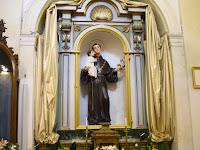 this place was once a thick forest where he was burned for the construction of the complex, but of all the trees there was a oak, which stood in the cloister of the monastery. This church was attached a confraternity of the Immaculate Conception was founded in 1583. The complex was dedicated to St. Francis and was completely rebuilt in 1764 and restored in 1797, the church is now called St. Anthony of Padua, formerly the main altar was his statue and a huge picture of the Immaculate Conception. In a chapel to venerate a statue of St. Francis, from the early years of the 300, another in a bas-relief of the Madonna delle Grazie, attributed to the school Gagini. It is located in the city's main square, its bell tower was one of the towers of the city, the monastery it once stood against the walls.
Today the church is linked to the Matrix The statue is placed in the first altar on the right, then there is the Madonna, and finally the Ecce Homo, on the left side we have the S. Francis, in following a cross (maybe from the church del Carmine). The church has a nave There is a strong devotion to St. Anthony of Padua, and by entering you can still see remnants of old buildings. (see photo on the page massively images of churches)
5) Church and Convent S. Augustine : The convent was built in 1400, founded by General Falciglia, but the church is expected to res  alga to 1250 under the title of Saints Philip and James, who had tied a Brotherhood gift that your church to the Augustinians in 1400.
The church had a number of changes over time in the 60 \\ 70 was the seat of the parish of the chain, and in the 80's temporary seat of the parish Matrix. In recent years it has been restored to its former glory, the church houses the Museum of silver and vestments.
main altar is a large choir and a wooden altar at the center with the urn under the Martyr St. Vincent, top the canvas depicting S. Philip and James, the first right altar altar of the Madonna del Soccorso, followed by other three altars on the left side in the first, now under restoration, there is an altar S. Rita. The church has three large vaults for the burial of religious. The monastery complex is now home to some municipal offices. http://matricesalemi.blogspot.com/2007/07/alcune-immagini-della-chiesa-di.html 6) Church and Convent of Our Lady of Mount Caramel : It is thought that it was founded in 1423, was held in 1555 a chapter  province, the construction of the Church must be due to a certain benificio which Francesco Palermo is remembered in a plaque inside The Church is above the place of his burial. Formerly, the complex had been restored several times, had atrium, a courtyard and a column of. It was attached to a congregation under the title of Most Holy Mary of Mount Caramel, founded in 1588 by Fr Christopher Nuccio. In 1751 the church was ruined and rebuilt bigger, the time was considered the most beautiful church of Salem, was the stutua altar of Our Lady of Mount Caramel, there were six smaller chapels, including a marble statue of the Madonna and Child, attributed to Gagini, a chapel dedicated to St. Joseph, another to the Holy Cross, a chapel dedicated to the Annunciation. Important was also the chapel of the Assumption that the reconstruction the new building was gone. The main parties were those of Our Lady of Mount Caramel, July 16, and S. Joseph. In this church is a statue of the Prophet Elias, which was carried in procession when the looming drought (such as the December 21, 1747). The the earthquake completely destroyed the 68 or oday it is only a summer theater.
7) Church and Convent of the PP. of Terzordine : After the great earthquake of March 6, 1740, where he collapsed a large part of Mount Rose, this convent was swallowed by the ground. All the men managed to escape, nothing remained of the church not only the copy of the sacred image of the face of Christ (given by Father Santoro Sheen). The
Pirri mention that this was the third monastery founded in the Kingdom, is believed to have been founded by some of the Bruno family. It was a strong foundation and its balconies one can admire a beautiful landscape. According to a legend in a cave near the monastery, he lived for a few days S. Calogero.
According to the news of Cremona, the men built a 'another convent at a place within the city where they had to withdraw after the landslide and where they had a tavern. The new church was small as the old church dedicated to Holy Mary of Jesus the high altar was a painting of the Visitation of the Virgin and another copy of the holy face of Jesus, had 4 low altars including that of S. Calogero. Under the building there are different religious burial crypts.
According to the news of Bavaria, the men managed to escape unless otherwise bring into sacred objects of the ancient church, including a crucifix (which confuses the men had their Capuchin convent near), and were housed in the convent of S. Augustine, then managed to build a new convent next to a church dedicated to Mary, where they had an inn, but for economic reasons, the convent was abolished and remained the only church. We do not possess reliable information on this church.
8) Parish Church of St. Francesco di Paola, the former Convent of the Minims : According to the source of Cremona, 16 years after the death of the saint, were present in Salemi  two minima in the year 1529 and obtained the grant of land around an ancient church dedicated to St. Sunday, located in the district that Serrone. Thanks to the alms of the Confraternity of S. Lucia, who took their willingness to give the Friars their Church as long as they had maintain the high altar statues of the Virgin and St. Lucia Agate. The minimum
built their monastery around the year 1559, this church built in two large crypts, one for the comp S. Lucia and the other for the Friars.
In 1757 the church was rebuilt with a more modern, is of this period shows an ancient bust of the saint. In 600 the church will be remembered by the name of S. Francesco di Paola and spread a great veneration to this Saint.
altar, after the discovery of an ancient statue of the Madonna in 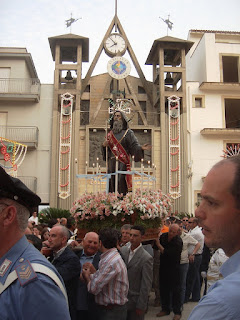 near the territory of the Church, the center of the two statues the brothers as they placed this image of Our Lady of Salty.
Because of the earthquake of 68 the church was razed to the ground and wish of the parish priest and devotees of the saint was rebuilt from the ground up, we find an altar crucifix that was once placed in one of the chapels of the ancient church, in the first altar on the right the statue of Our Lady of Mount Caramel, once placed in his Church, in the second right the altar of St. Francesco di Paola with a beautiful wooden statue, a marble slab at the base of 1620. In the third altar on the left a painting that depicts St. John Ev. Over the altar on the left in the first body is located, in accordance with the statue of St. Lucia, once placed at the altar greater, and the third painting by S. Michele Arc. The area in front of the aisles on either side are two niches, a statue of St. Antonio Abate, coming from his church, and in the S. Agata, once placed in the major. Under the church there are two large crypts with other altars. The church was raised to 80 in the parish and the Shrine.
9) Mary Parish Church in the Holy Transfiguration of Our Lord Jesus Christ of Confusion and the Convent of the PP. Capuchin : Initially there on Mount Rose, near the close of the convent of the Third Order, slightly down with the earthquake of 1740 but also was completely destroyed. This first monastery dates back to 1589, was approached by a road paved with stones, this church was the place where once was the church of S. Agata, it was dedicated to the transfiguration.
After the strong earthquake, the friars obtained from Mr. Frank Scurto, in 1743, a large piece of land near the near the church of S. Leonardo, there they built their new monastery and church dedicated to the Transfiguration of Our Lord Jesus Christ
high altar was a painting of the transfiguration, he had 4 other altars low, including that of the Holy Crucifix which according to legend, I speak on a brother, another was a picture which depicted the dream that he had a brother on the destruction of the two convents, where Christ is pictured with the anger toward the Virgin and S. Salemi Nicola, S. Blaise, S. Francis and other Franciscan saints who pray the Lord to spare the city.
In this new church altar the crucifix that was displayed at one time was the first monastery (according to the source of Bavaria).
After the earthquake of 68, the church has fallen in part, in fact the entrance to the sanctuary and was changed into a circular shape and the old part is still visible with some change of altars, including one dedicated to St. Bernardo da Corleone, the one on S. Francis, a 'more in S. Leonard, an Our Lady of Sorrows. Today the church continues to be the parish, but continues to be barely Capuchin monastery, the lack of them. The church is home to a great devotion to Our Lady of Confusion, that you do not have historical data.
10) church was St. Mary of the Angels SS Vito and former Convent of the Friars of the Strict Observance : These friars were also called Zoccolanti or reformed, the convent building was next 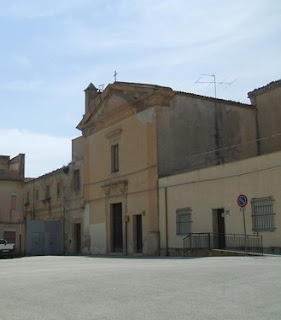 ancient church of S. Vito and his companions. The people wanted to erect in honor of Salemi wonders of God's servant F. Innocent Closed. Its construction began in 1622 and a few years later he was already inhabited by monks, even if under construction.
The monastery is one of the most beautiful and perfect, the old church was rebuilt and dedicated to Our Lady of the Angels. Altar, which belongs to the family and Scallops Perollo, there is a large painting depicting the Virgin and some saints feet. He had seven altars, including that of S. Pasquale Baylon, with its very ancient statue, another altar with a statue of the Madonna and Child, an altar dedicated to St. Vito with a statue of the ancient church, the chapel was one of the most prodigious SS Crucifix http://matricesalemi.blogspot.com/2007/07/il-crocifisso-di-fra-umile-da-petralia.html . carved by the artist Fra Umile Petralia, the chapel belonged to the Baron of Thomas Giardinello Clemenza. In honor of the Holy Cross on May 3 was organized a solemn feast. This church, next to the chapel of St. Vito had a big crypt for the burial of monks and citizens around it today tabs, the city cemetery.
12) Church of SS Mary Chain : ancient times was called Purgatory, dates back to early 1060, when the  Sicily was liberated by the Saracens, the people Salemi thanked the Virgin for deliverance from this chain, the church was built dedicated to the Madonna della Catena.
for its antiquity through the centuries has been restored several times and gradually decreased its size. According to some sources on the site of the church there was a synagogue. Thanks to Baron
Giardinello, Thomas Clemence and Sac. Andrea Lombardo, the church could be restored several times, as the great dome in 1734 for the purpose ruin.
altar, in the tribune, was exposed to a large painting of the Virgin and Child with his feet, kneeling, and the Baptist S. Francis of Assisi. He had four other shrines including that of Our low which was attached a confraternity called the "seven sorrows of the Virgin." Another altar was that of Patriarch St. Benedict. This church was connected with a congregation that is committed to compliance with the commandments and in prayer for the souls in Purgatory, founded in 1590, was called Purgatory. In the year 1609 to the time of the visit of the holy Bishop La Cava, for his will to the parish church was elected the first pastor was James Milana, then follow Alberto Oliveri and so on. In early 1960 the church was in poor condition and was destroyed to rebuild, but work is halted due to the earthquake of 68, still remains only the side walls and the parish house. At the time, until the '70s, the parish was moved in the Church of St. Augustine.
13) Church of Mary of Mercy : In this ancient church is venerated image of the Virgin painted on 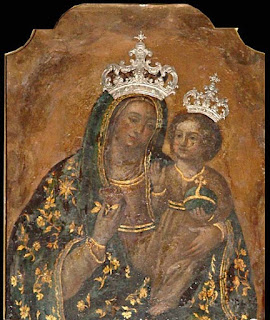 a wall of an old house in the neighborhood of the Giudecca. It dates back to early 1600 and is home to an ancient Marian devotion in this Salemi.
In 1622 the Discalced Augustinian Fathers wanted them to found a convent adjacent to this church but for unknown reasons abandoned this project.
Marian devotion in this church has always developed and enriched by faith until 1758 when it was decided to enlarge the church. It is medium in size decorated with stucco and particular elegance.
high altar is the miraculous image of Our Lady Venus, has four side altars where these (in the far right) keeps a statue of St. Isidoro Agricola to which is attached a confraternity that met every evening once a month and offered a good amount of wheat to the church.
benefactor of this church was the priest Peter Orlando, the main festival fell on the day of Pentecost.
It is said that one day a hailstone fell at the threshold of the church and soon became hard as a stone, since this item was jealously guarded as a gift of the Virgin.
Today the Church continues to be home parish Vigil Mass is celebrated only.
14) Church of St. Biagio : Branch to the matrix was a parish in the district anger, and of average size with four side altars: the right side,  in the first, we have a painting of the Virgin Mary between St. Biagio S. Nicola, in the second, a painting of Saints Philip and James, this altar is linked to a fraternity under these saints. On the left side, in the first,
  a painting depicting St. Rocco (this painting was considered the best in Salem to represent this holy) in the S. Isidoro agricultural
L 'altar is of medium size, has a statue in the gallery of the owner of good quality and expressiveness, in gilded wood.
The church was crowded in the Christmas novena and all the Fridays of Lent, where a Jesuit priest took some meditation on the Passion of Christ. This church was attached a confraternity under the name of the saint. Today it continues to be visited only during the feast of St. Biagio.
15) Rosary Church : amounts its existence from 1536, next to it there were rooms for the sick and a hospice for the .jpg) pilgrims.
pilgrims.  the main altar is a painting depicting the revered Virgin of the Rosary and of particular value tarbernacolo was completely covered with silver (now housed in the Mother Church, will shortly be possible to visit), the church was made up of 4 side chapel: in a to venerate a statue of Lady of the Rosary, in another a Crocicifisso (now preserved in the rooms of the Mother Church), another altar was dedicated to St. Gaetano, and another to ' Assumption of the Virgin. In the early years of the 700 it was decided to restore it completely as it was one of the most visited churches in Salem. With the earthquake of 1968 the church was damaged and now it is only the facade and the walls.
16) Church of the Holy Spirit or the Virgin of Montserrat : Already in 700 the church there in 500 was of great veneration among the people, speaks of the notary Domenico Majo in 1653. Was placed far the largest church adjoining the house of Francesco Cutrona and Joseph Cascio.
17) Church of Mary High : Already in 700 there was located the ancient city walls on the side that looked to noon, call high for the high position on the site. The site was granted by the Convent of St. Augustine, was once a ruined house, until 1625 was feet.
18) Church of St. Joseph : dates back to the expulsion of the Jews in Sicily, stands right in the neighborhood of the Giudecca, until the year 1665  was only then will the two altars Leonardo Barone Palermo and Mr. Joseph Bruno, the church was extended with four high lows, including that of the Marriage of the Virgin Mary, where every January 23 celebrated a solemn festival.
high altar was a statue of the saint, which was of great beauty, the festival fell on March 19 and Wednesday all the seven days preceding the solemn rites were celebrated. In 1761 he was decorated with stucco carvings and the will of the Rev. Ignazio Beat the ceiling was increased to full sail. The Jesuit
Mario Stanislao introduced in this church a special devotion to the Child Jesus, was preserved in a beautiful wax statue of the Child.
The 25th of each month the Blessed Sacrament was exposed, this church was linked to a brotherhood and below its bases there are two crypts for burial of the dead.
Today was restored by the will of the Archpriest and tidy for a few months has been the site of the oratory.
19) Church of St. Giovanni Battista : Built around 1500, was restored in 1760 by the will of the Sac. Santo Asaro. Initially the structure was with six smaller altars, then decreased to 4, among which was that of S. Martin, another dedicated to the Holy Bishop Aloe, and another to St. Crispin and Crispin.
high altar there was a statue of John the Baptist, this church was connected to a brotherhood that is committed to the worship of this saint.
Today the church has gone to the City and is used as an auditorium.
20) Church of St. Clememte : these communities of S. Annedda, is small in size it is linked to the Brotherhood of St. Anna, or humiliated.  adepts had to be only 72 and only they could attend this church, the people could enter this place until the evening of Wednesday and the morning of Holy Thursday and the Feast of St. Anna.
The congregation met and practiced many penances also flagellation, the church was annexed several small cells where the comp would retire it was founded in 1650, met early in the sacristy of the church of the Rosary, then in a large room of the Marquis Torralta, but later decided to buy a house that belonged to Mr. Catherine Vesco in 1734 and built the church.
Every Friday we took the dead Christ el'Addolorata, followed by all the sacred objects of passion. http://matricesalemi.blogspot.com/2007/07/immagini-delle-tele-della-chiesa-di-s.html
21) Church of St. John IV : will ruin the 1600, was sold to Baron Leonardo Palermo, and devotion to the saint was moved in the great church with an altar.
22) Church of St. Stefano : Perhaps it was the first church built in Salem, and medium-sized, high altar was a painting brush greek depicting the Virgin Mary between St. Michael and the Apostles, this picture above was another painting of the crucifix which was capped by a small dome.
In the upper right corner, in the first altar, a statue of the Holy Cross, in the second, a picture of Our Lady of Sorrows, on the left side, in the first, a wooden statue of San Stefano in 1568 and second in another altar with alabaster statue of St. Stefano of 1511, donated by Leonardo D'Amico, the church was attached a confraternity.
The church was located in the lower area of \u200b\u200bthe city near the door Corleone. Over 60
was for some time the parish seat of the Chain, the earthquake of 68 was destroyed, is now only part of the facade and the left wall. The site of the Church was strasformato in the center square with the alabaster statue of the Holy Martyr.
23) Church of St. Antonio Abate : Outside the city for a time there was a church 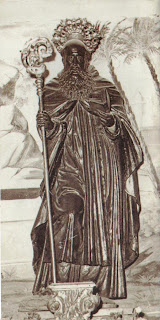 dedicated to this saint, but around 1565 it was in poor condition and it was decided to move inside the city. It is situated beside the church of S. Stephen goes back to 1761, and of medium size, high altar was a wooden statue of the saint, dated 1565, and 4 had low altars including one of the Immaculate Conception. This church is a brotherhood bound under the Holy One.
Even before the earthquake of Belize, the church was closed, with the earthquake has suffered extensive damage, the statue of the saint is now in the Church of St. Francesco di Paola. Today the building is closed, you can only admire its facade.
24) 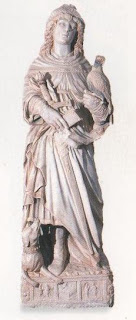 Church of St. Giuliano Confessor : Formerly located in the district said Gibli but was ruined in 1650 and instead formed a courtyard, known as S. Julian, with a few houses around, but for the veneration of the saint will be dedicated a side altar in the great church (the first left and you still had the marble statue of that church).
The construction and maintenance of the altar was the will of the Dukes of Villa Fiorita, heirs to the family of Cutrona Salemi.
On January 29, celebrated a solemn feast the people flocked to the holy where Salemi especially those who were threatened with murder. Today
private Matrix, it just keeps the marble statue at the Museum of Sacred Art.
25) former Church of St. Bartholomew St. Apollonia : Initially, in 1500, this church existed in the area known as rua (gibli), but  we decided to take the place of another church dedicated to the virgin Apollonia, as that of the Holy was in ruins. The Church of the Holy is next and goes back to the current array 16o0. Was enlarged and decorated with stucco work by the architect Peter Bolognese. The main altar is a painting of the Resurrection with Mary Magdalene, one of the side chapels was the statue of St. Rev. Bartholomew. and the other that of Saint Apollonia. By this time the church was named St. Bartholomew. Was attached a confraternity under the title of saint, and a congregation that founded the charity in 1611, was initially tied to this church then moved into the church oratory of S. Anna and subsequently returned to this church. Formerly occurred in this church the rite of the Last Supper and washing of the feet of the brotherhood of mortified. Today the church of S. Bartholomew is home to the Museum of the loaves.
26) Church of St. Margaret : was near the ancient Church of the Rosary, there is no news of his memory and his precise location of the building because the building was once occupied by the houses. The Cremona tells us only that it existed in 1653 but already in ruins.
27) Church of St. Catherine vm .: The first church was ruined and rebuilt it on any site just close the first church was built before 1600, the second is from 1670. He was with only one altar to venerate a framework where small size depicting the saint, the church had a few decorations, the holiday fell in the month of November. Was attached a confraternity and the company of Whites who were responsible for assisting the condemned.
28) Chiesa di S. Giacomo Apostolo : Situata nella contrada detta S. Giacomo, già al tempo del Cremona era in rovine, da lui veniva chiamata spelunca latronum .
Nel giorno della sua festa accorreva tanta gente, era di mediocre grandezza, rivolta a ponente e circondata da tanti giardini con frutteti e fiori.
29) Chiesa della Madonna della Scala : Non si hanno notizie della sua fondazione, era situata fuori la città, a ponente nella strada che porta a Trapani, situata su una montagna, la strada che led to it was seen by the people as a ladder so she was called by that title. Include many miracles, and every year in the third feria rogation he carried the image of Our Lady in procession. Then some priests wanted to build next to this church some cells where to retire for a few moments (oratory or withdrawal of pious priests), but these places were never inhabited and destroyed over time.
30) Church of Our Lady of Grace : Formerly a small kiosk where he worshiped painted on a plaque with the image of Our Lady of Grace, following the wishes of the people in 1605 it was decided to expand it in 1623 as a chapel and increased devotion to Mary, will of the people of the Archpriest and it was decided to build a real church.
The feast fell on August 5, and later it was decided to pave the road with stones that led to this site. In 1761, the decaying building was rebuilt from the ground up respecting the original order was placed outside the city walls to the east and turned his gaze to the west, was buried in this church a certain Vincenzo Polizzi, benefactor.
After the earthquake of 68, the church did not suffer some damage, it was decided to remove it from the same area.
31) Church of Our Lady of Badaluque : The church is of ancient buildings, is expected to be made by the Spaniards, was located in the district ciardazzi said, near the convent of the fathers of the third order and on the road leading to the church of the Madonna della Scala.
is revered ancient image of the Madonna painted on a plaque appeal Badalucco. You already ruined the end of 600, and was only a chapel in his memory. This site was considered one of the first Marian shrines in the area.
32) Church of St. Cosmas and Damian : one of the first churches built in the countryside of the city, in the area commonly known as the Pirani, the church has always been of private property, the holy liturgy was celebrated in particular in the days of the end of September, the feast of Saints Cosmas and Damian, people came in this large church with great reverence at these holy doctors. The property has a single nave, simple without side chapels, the main altar houses the image of saints painted on stone, the church can accommodate up to 200 people.
33) Church of St. Ciro : By the will of the Father Ignatius Roberti, the Society of Jesus, was bestowed the land on which to build this church. Construction began on 16 October 1741. The feast of the saint fell last Sunday in August. Altar houses the marble statue of the saint.
34) Early Christian Church St. Michael : The building was excavated by Antonino Salinas and was published by Biagio Pace. The church is divided into three 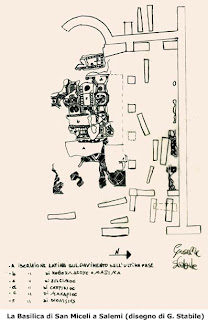 aisles, an apse on the west side and presented a narco on the east was also a destination as evidenced by the numerous funeral tombs found on pavimento.Lo excavation revealed identified three phases, from newest to oldest, with the letters A, B and C. A phase remains on the most recent phase of the church are very scarce. The most interesting element is composed of a mosaic fragment found in the eastern half of the nave bearing the Latin inscription "... ... MPORIBUS NTIFICIS Patris Bishops' ... OMINUS ... DO ... NORIS ... F. .. Ioli ... EC ...". The epitaph contains perhaps the allusion to a [p] ontificis Bishops' patris [opi]. Based on the design of the building the Peace attributed this phase to the sixth century. B dCFase This second time the basilica is characterized by another mosaic floor that was discovered beneath the mosaic with the inscription in Latin: it is characterized in its western half by a geometric pattern of squares and octagons containing stylized floral motifs and in his mid- Eastern irregular quadrilaterals interspersed with diamonds, this part of the mosaic floor is also home to five entries, four of which bear Greek and Latin names of likely benefactors of the church and Kobouldeos Maxima, Zosimos, Saprikios, Makarios and Dionisius.Sulla first inscription reads "Kobouldeos Maxima split the vote and for the salvation of their children." Particularly interesting is the name Kobouldeos widespread in the Christian communities of North Africa and means "Quod Deus vult". This in my opinion shows that African teams in the late Roman era were still present in the western part of the island and that probably contributed to the spread of Christianity in these zone.La second inscription reads "The priest Macarius for the salvation of Kobouldeos. The type of inclusion appears to be a funeral but the loss of stratigraphic data can not be say this with certainty. This fragment of mosaic and refers to the restoration work, the latter, according to Pace, it could be referred either to the tomb of Kobouldeos built by the priest or to a restoration of Makarios wanted by Macario floor to honor the memory of the founder of the basilica (Kobouldeos? ). In the third inscription reads, "Remember, O Lord, your servant saprice" The name of this nell'epitaffio comes from greek "sapròs" "putrid" and is a rather common name among the early Christians who used it for humility derogatory names. According to the Peace that this inscription is that of Zosimos were funerary in nature while the Salinas were invocations the community. To me, the first hypothesis is more likely, because the text seems to speak of a clear desire by the faithful to rely on the verge of death at the hands of Dio.L 'unique funerary inscription is certain to Dionisius that says "The priest lived Dionisio 55 years in peace. "This second phase is due to the fifth century. dCSia the combination of mosaics and funerary inscriptions and the names are found in inscriptions from North Africa. The quality of the lower level floor of the basilica of Salemi, however, betrays a bill that made use of local African models circulating at that time in the western Mediterranean. (source: Giuseppe Stabile)
35) Church of St. Joseph : was located at c / from St. Joseph, now defunct, its construction is the work of the Family in Palermo that the district had the title of Baron together with the neighboring district of St. John.
36) Church of St. Nicola di Bari : arose in the district called Paradise, was small in size, was manufactured by Antonino Adamo around the years of 1670, was tied Archpriest, owned several gardens.
37) Church of St. Liborio : pisciapolli Located in the district, was built in 1677 by Giuseppe Patella and finished in the same year, the size is super down as a chapel, with only one altar. The church was attached a garden and a vineyard. Today there remains only some remnants .
38) Church of St. Agata : stood in same place where once there was the convent of the PP. Capuchins in 1740 that was destroyed by the earthquake.
39) Church of St. Leonardo : Old is the devotion to S. Salemi Leonard of Limoges, we know that until all'anno1534 was very crowded, was situated near the area called the Vado has been restored several times, in 1660 the Rev. Joseph De Blasi, the restored and embellished with a large picture of the saint, after restoration will be taken up by the family Villaragut.
41) former Monastery Church of the Immaculate Conception of the enclosure : Its foundation was thanks to the work of Baron Giardinello, Thomas  Clemenza, the opening of this complex occurred in 1723 . In addition to the monastery of cloistered nuns, lived the "pious maidens" which observe the same rule of the Sisters of the oratory of S. Anna.
main altar is a large picture of the Immaculate Conception, and there are six altars low.
cloisters of the monastery was located next to the church from the bottom, instead of the other was part of another building where lived the "pious maidens" and then a congregation of nuns. The church has a nave, rich stucco decorations, the high altar is surmounted by a large painting of the Immaculate Conception and its sides are two paintings, the Archangel Michael on one side and the other gabbriele the archangel. The structure consists of three side chapels: the first right is the most decent, contains the launches of the Assumption, the walls of the altar are painted artistically, based at the altar there is another which contains the body launches S. Illuminata. The second contains a painting which depicts St. Nicholas of Myra, St. Anthony Padua, St. Francis and basically self-portrait of Brother Felix, who has painted this painting. The third chapel has a painting of the Flagellation of Christ. The area starts from the bottom left of the first occupied by a chapel organ, the second with a painting of the washing of the feet and the third with the Crocofissione. The church dates back to 1723 and is subsidiary to the Matrix. (See pg. Image of the church: http://matricesalemi.blogspot.com/2007/08/immagini-della-chiesa-della-concezione.html
42) Church of St. Anna Oratorio : In this oratorio some young virgins lived under the rules of S. Benedict, the church is of medium size, the main altar is a painting of St. Anna, in the upper right-left in a crucifix and a painting of St. Benedict. The church dates back to 1718, the founder of this work was P. The Nuza. Today the church has gone to the town-owned.
43) Church of St. Thomas the Apostle: It is located next to  church of S. Blaise, is believed to have been built by the Goths and the Greeks, should go back each year 1539, is medium in size, the main altar is the statue of the titular saint, in marble, the sides had only two side altars, one was kept in a prominent statue of Ecce Homo. was always attached to a brotherhood. Today the church is closed and in disrepair.
44) Church of Our Lady of Miracles : Also called the cuts or Pirrera for the site where he was. It was dedicated to Our Lady of miracles to the miracles that occurred. This is built in 1500, was small, the main altar is a painting on the wall of the revered Madonna, had only a low altar. A member of this church was the painting of Our Lady of the Angels of Emery who then was accidentally brought the old array and another of less value was placed on the high basso.Ogni year to March 25, then the Sunday after Easter, from the Matrix started a procession to this church, next to this church there was a miraculous well. Today there remains only his building became a garage for a few people who live in that ward.
45) Church of St. Sunday : early 1700's was almost completely demolished, was part of the territories that were granted for the construction of the convent of the Minims. Formerly it was built after the missions that operated on this Holy Father and inspiring much admiration among the people for S. Sunday it decided to build a church in her honor.
Bibliography: THE CITY 'of Salem, Father. GS Cremona. Transcription of the old manuscript of 1762.
MEMORIES OLD CITY ON 'of Salem, FS Bavaria.
______________________________________________________
MAPS on Salem in different historical periods
Arab domination period
Norman and medieval period Svevo
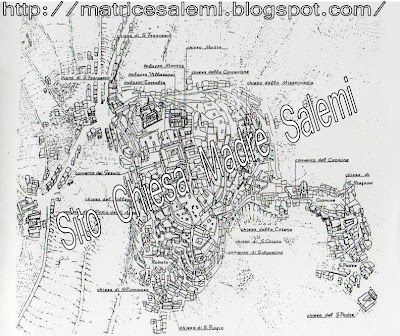 period XVI to XVIII
 Mother Parish Church St. Nicola di Bari - Salemi
  Lent is a time of preparation for the Passover of the Lord. Easter is man's salvation is a gift to humanity, it is therefore necessary that our life is prepared to accept this gift. The Lenten season is favorable opportunity that we are given every year to change our lives which is often enslaved by sin and therefore marked by sadness and death. At this time, the Church invites Christians to practice the works of fasting, prayer and listening to the Gospel. These practices are useful and necessary to all those who want to feel free from sin, to live in joy and serenity. By fasting, Christians do not mortify the body, but remember that their body is more than just instinct. Fasting , which must be practiced on Ash Wednesday and Good Friday, is limited to essential food. In every Friday during Lent we abstain from meat. Along with the need to act fast is prayer, without it our fast losing its sense of purification. Listening to the Word of God , the Gospel, especially in the liturgy for Sundays of Lent, it must be for all Christians when true encounter with the Lord. During the period of Lent remember to make acts of charity towards the suffering and offers alms to the poor who are on the right and we often forget or avoid. Over the past and those who suffer to manifest the presence of the Lord.
 FEAST 'OF ST GIUSEPPE


.jpg)


 PASTORAL PLAN 2010 - 2011


 In the highest part of Salemi, which constitutes the acropolis town, there was the Mother Church and according to sources at that site was a temple dedicated to Venus and after that an Arab mosque. In this square stands a majestic castle built by King Frederick II and the region, which stood the church, was nothing but a plot of the castle, in fact the


 else in the church after the earthquake (no excessive damage)


 1 photos chapel of the Crucifix, the Chapel of S 2 photos . Nicola after the earthquake
  In this last photo that I propose you can see what he had to endure our matrix due to human then. Its destruction that you see here was not due to the earthquake but the whole work of man.


.jpg)
.jpg)